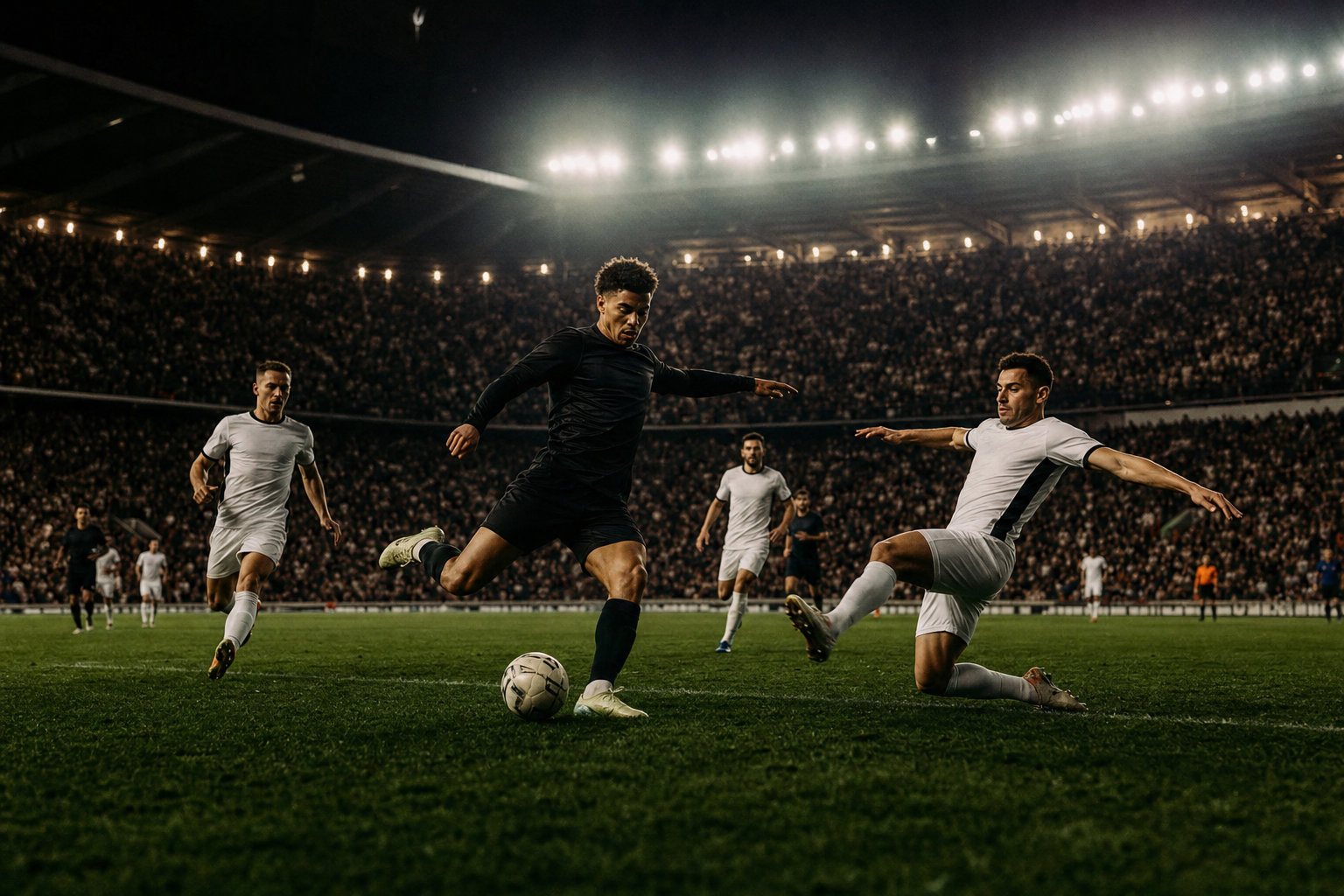
Man Utd 2–1 Bayern Munich — UCL Final 1999
How Manchester United came from behind in injury time to beat Bayern Munich in 1999 and complete the first treble in English football.
In the eighty-ninth minute of the 1999 UEFA Champions League Final at Camp Nou, Barcelona, the scoreboard read Bayern Munich 1, Manchester United 0. The match was four minutes from becoming one of the great German club triumphs in European history. What followed in the next four minutes of injury time produced a result that has since been cited, replayed, and written about more than almost any other single match in football's modern era. Two goals in two minutes of added time from substitute Teddy Sheringham and then Ole Gunnar Solskjaer delivered United's first European Cup since 1968 — and completed, in the most dramatic fashion conceivable, the first treble in English football history.
Starting Line-ups
Manchester United (4-4-2) — Manager: Alex Ferguson
Peter Schmeichel; Gary Neville, Ronny Johnsen, Jaap Stam, Denis Irwin; David Beckham, Nicky Butt, Ryan Giggs, Jesper Blomqvist; Andy Cole, Dwight Yorke.
Substitutes used: Teddy Sheringham (for Blomqvist, 67') · Ole Gunnar Solskjaer (for Cole, 81')
Bayern Munich (approx. 3-5-2) — Manager: Ottmar Hitzfeld
Oliver Kahn; Samuel Kuffour, Thomas Linke, Lothar Matthäus; Markus Babbel, Stefan Effenberg, Jens Jeremies, Mario Basler, Michael Tarnat; Alexander Zickler, Carsten Jancker.
Substitutes used: Mehmet Scholl (for Basler, c.72') · Thorsten Fink (for Matthäus, c.80')
Starting XIs compiled from widely cited match reports and secondary sources. Exact positional placements may vary; UEFA official records are authoritative.
Context: The Treble Campaign
The 1998–99 season represented the peak of Alex Ferguson's first great Manchester United dynasty. A side built around Peter Schmeichel in goal, Gary Neville and Denis Irwin at full-back, Jaap Stam anchoring the central defence, Roy Keane dominating midfield, David Beckham providing width and set-piece quality, Ryan Giggs offering speed and directness, and Andy Cole and Dwight Yorke forming the Premier League's most productive striking partnership of the season had pursued three simultaneous targets throughout a gruelling and increasingly extraordinary campaign.
The Premier League title had been secured on the final day of the domestic season, edging out Arsenal on the last day at Old Trafford. The FA Cup Final had been won against Newcastle United six days before Camp Nou, with Sheringham and Solskjaer both scoring in a comfortable 2-0 victory. The Champions League Final was the final piece — and the most consequential, representing United's first European Cup final appearance since 1968 and the achievement that would define Ferguson's legacy in a manner that domestic success alone never quite could.
The Suspended Leaders
Ferguson faced the final in a compromised position that might have destabilised a less cohesive squad. Roy Keane, United's captain and the driving force of their midfield, was suspended after accumulating a yellow card in the semi-final against Juventus. Paul Scholes, the creative midfielder who operated between the lines and who had been among the most influential players in United's campaign, was also suspended for the same reason — both had been booked in the second leg of the semi-final against Juventus, ruling themselves out of the final.
The loss of Keane and Scholes from the midfield represented a significant reduction in United's usual quality and tactical intelligence in the central areas of the pitch. Nicky Butt deputised in the defensive midfield role, while Jesper Blomqvist — rather than the more naturally creative players who usually occupied that wide-left position — started in a squad that was notable for its absence of the two players most central to the club's competitive rhythm in 1998–99.
Keane would later say, reflecting on the final, that his overwhelming emotion watching from the stands was one of pride in the collective achievement rather than personal regret at his own suspension — a comment that spoke to the team culture Ferguson had built rather than the tactical gap his absence created.
Bayern Munich: The Dominant Opponent
Bayern Munich in 1999 were a formidable opponent by any measure. The Bavarian club were in the midst of a competitive period under manager Ottmar Hitzfeld — the same manager, notably, whose Borussia Dortmund side had beaten United in the 1997 Champions League semi-finals. Bayern's squad included Stefan Effenberg in midfield, a physically imposing and technically accomplished player who controlled the tempo of matches through positional intelligence and set-piece delivery; Carsten Jancker and Giovane Élber as attacking options; and a defensive structure of considerable organisation and experience.
The match also carried a degree of personal narrative: Lothar Matthäus, the German football icon whose career had stretched from his earliest professional years through multiple Bundesliga titles and the 1990 World Cup, was part of Bayern's squad for what was widely understood as the end of a remarkable career at the highest level. The Camp Nou occasion represented, for several members of Bayern's squad, what they had every reason to expect would be the defining achievement of their careers.
The Match: Bayern's Control and the Sixth-Minute Goal
Bayern Munich established control of the match from early in the contest. Mario Basler — a technically skilled wide midfielder known for the accuracy of his dead-ball delivery — gave Bayern the lead with a direct free kick in the sixth minute, bending the ball around the wall and past Schmeichel. It was a well-taken set piece that gave Bayern a platform from which they managed the match defensively, without seeking to extend their lead aggressively.
Hitzfeld's Bayern were a side of tactical pragmatism rather than offensive ambition once ahead in European matches — a common and defensible strategy at that level. United were given no clear path through the Bayern defensive block and struggled to create the clear opportunities their attacking personnel was capable of generating in domestic competition. The absence of Keane's forward driving runs and Scholes' capacity to find pockets of space behind the opposition midfield was tangible throughout the first half and much of the second.
Bayern came close to extending their lead at moments that would have made the final result a formality. Mehmet Scholl, on as a substitute, struck the post with a chipped effort that beat Schmeichel. Later, Carsten Jancker connected acrobatically from close range and struck the crossbar. Both near-misses would, in retrospect, carry enormous significance — the margin between a comfortable Bayern victory and the circumstances that produced United's comeback was precisely the width of those two pieces of woodwork.
Ferguson's Substitutions
Ferguson's approach to the second half and the substitutions he made reflected both the desperation of a losing scoreline and the attacking resources available on his bench. Teddy Sheringham, who had been a key player for United during the season and who had already scored in the FA Cup Final, came on as a substitute in the second half. Solskjaer, whose sharpness and instinctive finishing had made him one of the most effective impact substitutes in European football, was introduced later.
Peter Schmeichel — playing the final match of his seven-year association with Manchester United — went forward for a corner in the closing seconds of injury time, an act of tactical desperation that also carried the symbolic weight of a great goalkeeper making his ultimate contribution to the club he was about to leave. That Schmeichel's forward run created the distraction and uncertainty in Bayern's defensive shape that contributed to what followed was not planned in any detailed sense, but it was characteristic of United's refusal, under Ferguson, to accept the match's apparent conclusion until the final whistle.
The Final Minutes: Sheringham and Solskjaer
The scoreboard showed three minutes of added time. David Beckham swung a corner into the Bayern penalty area. It was not cleared cleanly. In the scramble, Sheringham redirected the ball into the net: 1-1. The Camp Nou crowd — overwhelmingly United-supporting — produced a noise that had not been heard during the previous eighty-nine minutes.
Bayern's players were visibly affected. From having been ninety seconds from victory, they were now facing a draw and the prospect of extra time. The psychological transition from a position of security to sudden equalisation is one of the most disruptive experiences in football, and Bayern's collective defensive organisation showed the signs of it.
From another corner — again Beckham delivering — the ball reached Sheringham, whose header or touch set up Solskjaer at the far post. Solskjaer's instinctive, close-range toe-poke looped past Kahn and into the net: 2-1. The match was over. United had scored twice in three minutes of injury time, in a Champions League Final, having been outplayed for eighty-nine minutes by a superior opponent. The referee, Pierluigi Collina, blew the final whistle moments later.
Significance: The Treble Completed
The Camp Nou result completed a sequence of achievement that had no precise precedent in English football history. No English club had previously won the league title, the FA Cup, and the European Cup in the same season. The combination of domestic dominance — United had finished the Premier League season a point clear of Arsenal — with continental achievement represented the culmination of a project Ferguson had been building since his arrival at Old Trafford in November 1986.
For Schmeichel, it was the perfect conclusion to his United career: the greatest goalkeeper in the club's history departing after his most celebrated night. For Keane and Scholes, watching from the stands, it was a validation of a campaign they had shaped without being permitted to complete. For Sheringham and Solskjaer — whose goals had decided the match — it was the defining moment of their professional lives.
Legacy and Tactical Analysis
The 1999 final is discussed as much for what it reveals about footballing contingency as for any tactical lesson it offers. Bayern Munich were the better team across the ninety minutes by most analytical measures: more controlled in possession, more defensively organised, more effective at restricting United's attacking threat. Hitzfeld's side was not outplayed or out-thought; they were beaten by two moments of set-piece quality in injury time, framed by the psychological disruption of a late equaliser.
The broader tactical legacy of the match is indirect. Ferguson's 1999 United were not a team that required detailed tactical analysis to explain their excellence — their quality was self-evident, and their vulnerability without Keane and Scholes illustrated precisely what those two players contributed that could not easily be replaced. The final demonstrated, as the best European knockout matches often do, that tactical superiority does not guarantee victory over ninety minutes when the margins of error are so fine.
United's achievement remains one of the reference points for discussions of single-season greatness in English football. For further context on that era of Premier League competition, and for the tactical history that preceded and followed the 1999 campaign, the league archive provides the broader competitive framework within which this final can be understood. The match archive also contains documentation of other defining European finals from the same era.
Frequently Asked Questions
What was the score in the 1999 Champions League final?
Who scored Manchester United's goals?
Why did Manchester United play without Roy Keane and Paul Scholes?
Why is this final considered historically significant?
Football Replay Editorial
Updated April 4, 2026