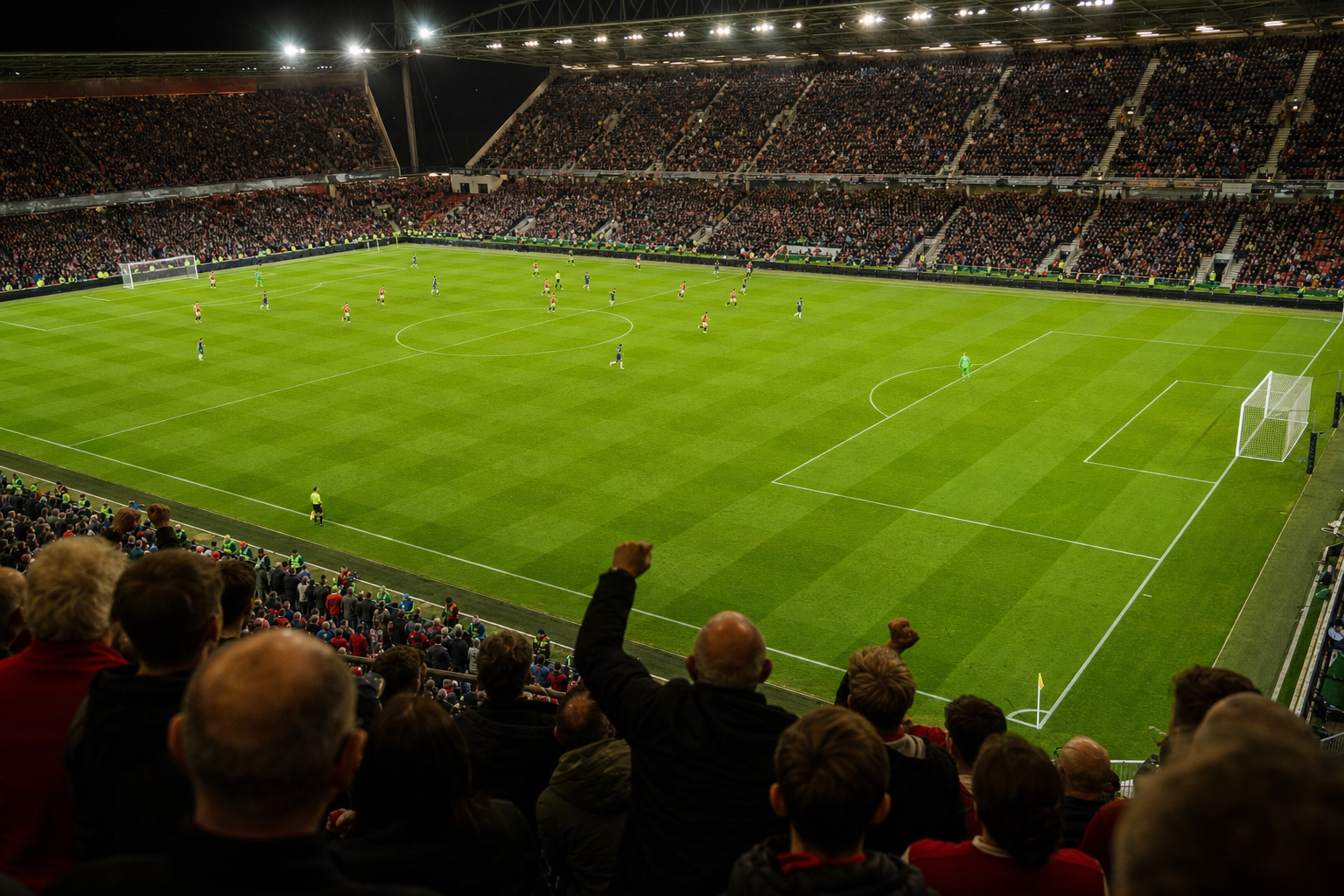
The Premier League stands as the most commercially successful domestic football competition in the world, generating annual revenues that consistently exceed those of any rival league. Its formation in 1992 — when the clubs of the First Division of the Football League voted to break away and negotiate their own television rights — represented a structural rupture in the history of English football that reshaped the commercial and competitive landscape of the sport globally.
The Football League's top division had existed continuously since 1888, making English football's top-flight one of the oldest in the world. The Premier League's formation did not break that sporting continuity — the same clubs competed, the same promotion and relegation system applied — but the commercial independence of the new entity allowed for a broadcast rights negotiation that produced a transformative financial injection into English football from 1992 onwards.
The initial Sky Sports broadcast deal, worth £304 million over five years, was followed by progressively larger deals as the Premier League's global audience grew and the competition for broadcast rights intensified. By the 2019–2022 cycle, domestic and international broadcast rights were generating over £4.8 billion per cycle, and the league's financial muscle relative to its European rivals had become one of the defining features of contemporary football.
Founding and the BSkyB Revolution
The circumstances of the Premier League's founding are inseparable from the media history of the United Kingdom in the early 1990s. Rupert Murdoch's BSkyB satellite broadcasting service, launched in 1989 and struggling commercially by 1992, identified exclusive live football broadcasting as a viable platform for subscriber growth. The Premier League clubs, recognising their collective commercial leverage, negotiated directly with BSkyB rather than through the Football League's existing structure.
The original Premier League season in 1992–93 was won by Manchester United under Alex Ferguson — the club's first league title since 1967 and the beginning of a dynasty that would dominate English football for the following two decades. Ferguson's side, built around players including Eric Cantona, Roy Keane, Peter Schmeichel, and Ryan Giggs, won thirteen of the first twenty-one Premier League titles and established a template for sustained domestic dominance that subsequent clubs have attempted to replicate with varying success.
Tactical Evolution: From the Long Ball to the High Press
The tactical history of the Premier League is a microcosm of the broader tactical evolution in global football. The league's early seasons were characterised by the physical, direct style that had defined English football through the 1970s and 1980s — high-tempo, aerial contests fought largely in midfield with a premium placed on athleticism over technical quality. The arrival of significant numbers of continental European players and managers from the mid-1990s onwards introduced a more technically sophisticated approach that gradually came to dominate.
Arsène Wenger's arrival at Arsenal in 1996 is the most cited single event in the Premier League's tactical transformation. Wenger introduced systematic sports science, dietary management, and a possession-based aesthetic that had no equivalent in English football at the time. The Arsenal double-winning sides of 1998 and 2002 demonstrated that technical quality and collective pressing could outperform the more physical English norm, and the competitive pressure this placed on rival clubs accelerated the tactical modernisation of the league as a whole.
The subsequent arrival of José Mourinho at Chelsea in 2004, with his emphasis on defensive organisation and set-piece efficiency, introduced a further tactical strand. The tension between Mourinho's pragmatic defensive philosophy and Wenger's possession-oriented approach — sustained across years of often bitter competition — became one of the most productive sporting feuds in Premier League history, and the tactical debate it generated shaped the coaching philosophy of an entire generation of English football managers.
Contemporary Premier League football is defined above all by the high-pressing game popularised by Jürgen Klopp at Liverpool and subsequently adopted, in various forms, by the majority of the league's top clubs. Klopp's Gegenpressing system — characterising a period at Liverpool from 2015 through 2024 — produced a six-year cycle of sustained excellence including the Champions League in 2019 and the club's first league title in thirty years in 2020. The tactical legacy of that Liverpool side has been to make sustained, intense defensive pressing the baseline expectation for Premier League clubs competing at the top of the table.
The Invincibles and Unbeaten Records
Arsenal's 2003–04 season remains the most celebrated single-season achievement in Premier League history. Wenger's side completed the entire thirty-eight-match campaign without a defeat — winning twenty-six matches and drawing twelve — earning the soubriquet "The Invincibles" that has passed into football mythology. The squad, built around Thierry Henry, Patrick Vieira, Ashley Cole, and Robert Pires, combined technical brilliance with physical conditioning and tactical discipline in a manner that has not been replicated in the three subsequent decades.
The unbeaten record of 49 Premier League matches — spanning the end of the 2002–03 season and the entire 2003–04 campaign — was not matched until Manchester City under Pep Guardiola mounted their own unbeaten run in 2017. City's eventual 2017–18 season, in which the club won 100 points in a single Premier League campaign, established new benchmarks for sustained dominance and prompted renewed discussion of how to contextualise excellence across different eras.
Manchester City's Premier League Era
Manchester City's Premier League story begins with the 2011–12 final day — Agüero's goal at Manchester City 3–2 QPR at 93 minutes and 20 seconds, ending a 44-year wait for the title in one of the competition's most documented finishes. Roberto Mancini's side set the platform for what followed under Guardiola.
Manchester City's achievement of four consecutive Premier League titles between 2020–21 and 2023–24 under Pep Guardiola is the most statistically dominant run of sustained excellence in the competition's history. While the pre-Premier League era saw both Liverpool and Arsenal win three consecutive First Division titles, and Manchester United won three in succession in 1999–2002 and 2007–2009, no club had previously managed four consecutive top-flight championships in England since the formation of the Football League.
Guardiola's City teams across this period represented a culmination of his tactical philosophy — the principles of positional play and ball-circulation he developed at Barcelona and Bayern Munich applied to a squad of extraordinary collective quality. The 2021–22 title, won on the final day ahead of Liverpool in the most competitive two-horse race in Premier League history, was arguably the most tactically sophisticated campaign of the four, with City navigating a Champions League semi-final exit to Real Madrid and a sustained domestic challenge from Jürgen Klopp's Liverpool without losing composure or tactical clarity.
Relegation and the Championship
The Premier League operates a promotion and relegation system with the Championship, the second tier of English football. The bottom three Premier League clubs at the end of each season are relegated to the Championship, while the Championship's top two clubs are automatically promoted and the third promotion place is contested through a playoff involving the clubs finishing third through sixth.
Relegation from the Premier League carries severe financial consequences. The loss of Premier League broadcast revenues — the "parachute payments" system partially mitigates the income shock, but even with parachute payments a relegated club operates at a significant competitive disadvantage relative to Championship rivals who have not recently been in the top flight. The financial reality of relegation has produced increasing risk-aversion among Premier League clubs, and several have been criticised for prioritising short-term survival over longer-term investment.
Conversely, promotion to the Premier League represents a transformative commercial event for Championship clubs. The broadcast revenue differential between the two divisions — typically a factor of ten or more — creates incentive for Championship clubs to invest speculatively in promotion campaigns, occasionally at the cost of financial sustainability. Several clubs have entered administration or faced severe financial distress following failed promotion attempts or swift relegation after achieving top-flight status.
The intensity of Championship promotion campaigns produces some of the most tactically and emotionally charged football in the English pyramid. Leeds United's 2018–19 season under Marcelo Bielsa — documented in the key fixture against West Brom — illustrated how a tactically sophisticated Championship side could fall agonisingly short of automatic promotion, losing to Derby County in the play-off semi-finals before returning as champions the following year.
Global Reach and Cultural Impact
The Premier League's global audience — estimated at a cumulative three billion followers across all platforms — reflects a combination of historical luck, deliberate commercial strategy, and the genuine quality of the competition. The league's establishment in 1992 coincided with the global proliferation of satellite television and the beginning of the digital media era, meaning it grew into a globally accessible product at precisely the moment when the infrastructure for global sports distribution was being constructed.
The demographic profile of the Premier League's global audience skews toward East and Southeast Asia, where the competition has enormous followings in markets including Malaysia, Thailand, Indonesia, Singapore, India, and China. Pre-season tours to these markets by major Premier League clubs are a regular commercial fixture, and broadcast rights deals in Asian markets have become a significant component of overall Premier League revenue.