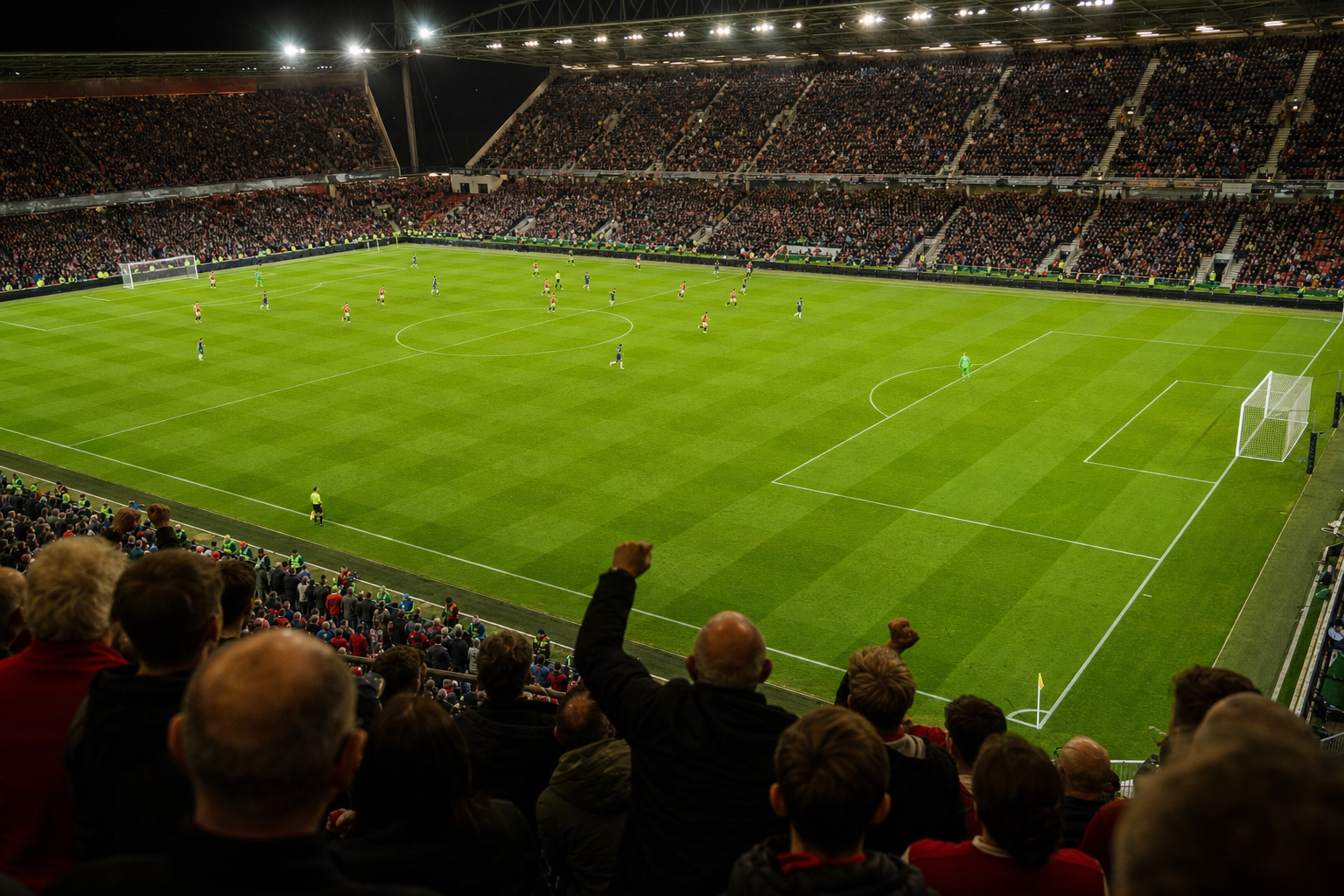
Manchester City 3–2 QPR — Premier League 2012
Agüero's winner at 93:20 ended Manchester City's 44-year title wait: a match analysis of the most dramatic final day in Premier League history.
At 93 minutes and 20 seconds on 13 May 2012, Sergio Agüero received the ball approximately thirty yards from the QPR goal, burst past two defenders with a sequence of rapid, close-controlled touches, and shot low into the net past goalkeeper Paddy Kenny. The result — Manchester City 3, QPR 2 — gave City the 2011–12 Premier League title on goal difference from Manchester United, who were winning simultaneously at Sunderland. The match is defined, in collective memory and broadcast archives, by the commentator Martin Tyler's sustained shout of "Agueroooo" as the ball entered the net: one of the most recognisable pieces of sports broadcasting in the Premier League's history.
Starting Line-ups
Manchester City (4-2-3-1) — Manager: Roberto Mancini
Joe Hart; Pablo Zabaleta, Vincent Kompany, Joleon Lescott, Gaël Clichy; Gareth Barry, Yaya Touré; James Milner, David Silva, Samir Nasri; Sergio Agüero.
Substitutes used: Edin Džeko (for Milner, c.69') · Mario Balotelli (for Nasri, c.76')
Queens Park Rangers (4-4-2) — Manager: Mark Hughes
Paddy Kenny; Taye Taiwo, Nedum Onuoha, Anton Ferdinand, Clint Hill; Joey Barton, Shaun Derry, Shaun Wright-Phillips, Armand Traoré; Bobby Zamora, DJ Campbell.
Note: Barton red card (c.55'). Goals: Mackie (66'), Campbell (48').
Substitutes used: Jamie Mackie (for Zamora, c.46') · Djibril Cissé (for Traoré, c.66')
Starting XIs compiled from widely cited match reports and secondary sources. Individual positions and substitution timings are approximate; Premier League official records are authoritative.
Context: The Title Race
The 2011–12 Premier League season had produced the most competitive two-club title race in the competition's history to that point. Manchester City, under Roberto Mancini in his third season at the club, and Manchester United, under Alex Ferguson in his twenty-sixth, had been level on points going into the final day. City's goal difference advantage meant that a City win would give them the title regardless of United's result — but a draw or defeat would hand the championship back to their neighbours.
The stakes could not have been clearer: City, owned since 2008 by the Abu Dhabi United Group and in the process of constructing a squad of considerable attacking quality, had not won the First Division or Premier League title since 1968. The club's supporters had lived through four decades of United's dominance of Manchester football during which multiple league titles, FA Cups, and the European Cup had gone to Old Trafford. The 2011–12 season represented the most concrete opportunity for that dynamic to be permanently disrupted.
The final day's schedule placed both clubs' matches in simultaneous kick-off, and the knowledge that both games would run concurrently meant every development in each stadium was immediately contextualised against what was happening in the other. At the Etihad Stadium, City were playing QPR; at the Stadium of Light, United were playing Sunderland.
QPR's Position and Motivation
Queens Park Rangers entered the Etihad in a relegation battle. The club, managed by Mark Hughes, needed a positive result to secure their Premier League survival, with other results around them creating a situation where a point might be sufficient depending on Bolton Wanderers' result elsewhere. QPR had a genuine competitive motivation that went beyond the conventional dynamics of a mid-table club playing an established title contender on the final day — they were fighting for their financial and sporting survival in the top flight.
Mark Hughes' side was set up to be compact, defensively hard to break down, and effective from set pieces and direct play. Against City's attacking quality — Agüero, Carlos Tevez, David Silva, and Samir Nasri among the options available to Mancini — QPR's best chance lay in maintaining their defensive structure for as long as possible and exploiting any transition opportunities that City's attacking intent might create.
The Match: City's Early Lead and the Barton Incident
City opened the scoring through Pablo Zabaleta, the Argentine right back who had become a reliable source of goals from advanced positions during the season. QPR equalised to make the match competitive, and the game settled into a pattern in which City's possession dominance was meeting organised QPR resistance.
The match's defining disciplinary event came when Joey Barton, QPR's midfield player, was sent off following a series of confrontations. After being shown a red card, Barton's exit from the field was marked by further violent conduct involving Carlos Tevez and Vincent Kompany, extending an incident that drew significant attention and criticism in its immediate aftermath. QPR were reduced to ten men, a situation that, in virtually every analytical model, would make a City victory more rather than less likely.
What followed inverted that expectation. QPR, with ten men, began to defend deeper and more cohesively, and the disorganisation that a red card can create in the attacking team — particularly when that team becomes increasingly anxious — played a role in creating the conditions for QPR's second goal.
QPR Take the Lead
Despite their numerical disadvantage, QPR scored twice to take a 2-1 lead. Jamie Mackie's goal — a header that gave QPR the advantage — produced one of the most astonishing scorelines in Premier League final-day history: ten-man QPR were beating Manchester City at the Etihad, with the title seemingly slipping away from City and back toward United. Reports from those inside the stadium described an atmosphere of escalating anxiety among the City supporters that had a tangible effect on the team's performance. City were pressing with increasing urgency but without the composure and positional discipline that their best football required.
At Sunderland, United were managing their game. The news filtering through to both sets of supporters at the Etihad meant that City needed not merely to equalise but to win. A draw would not be sufficient. The situation appeared, with time running out, to be beyond what City could achieve.
Dzeko, Then Agüero
In the 90th minute plus two, Edin Dzeko — the Bosnian centre-forward who had been introduced as a substitute — headed a corner into the QPR net to make it 2-2. The goal changed the immediate emotional atmosphere in the stadium but did not yet win the title: a draw would still hand the championship to United. City needed one more.
The 93rd minute and 20-second goal has been documented in granular detail by those who were present and by subsequent broadcast analysis. Agüero received a pass from Mario Balotelli — also introduced as a substitute — in a central position. With two QPR defenders attempting to close, Agüero accelerated through the narrowing gap between them, the ball appearing to remain under improbable control through the movement, and shot before either defender could fully commit to a challenge. Kenny, the QPR goalkeeper, did not stop it. The ball went in. The Etihad exploded.
The final whistle followed moments later. City had won 3-2. United had also won, at Sunderland, but it made no difference: City's superior goal difference had delivered the title to the Etihad on a final-day result that football will continue to reference for as long as the sport is played in England.
Mancini's City and the Tactical Context
Roberto Mancini's Manchester City in 2011–12 were not an aesthetically unified side in the way that Pep Guardiola's subsequent City teams would be — there was no overriding tactical philosophy, no distinctive possession style, no systematically trained set of pressing or positioning principles. What Mancini had built was a squad of individual quality sufficient to overcome most opponents through the application of that quality, organised around a resilient defensive base and an attacking variety that made City difficult to plan against specifically.
The QPR match, paradoxically, revealed the limitations of this approach as clearly as any other City performance that season: a well-organised, highly motivated opponent had disrupted City's rhythm, exploited the anxiety that a high-stakes occasion generates in a squad under collective pressure, and taken the lead with ten men. The rescue was achieved not through tactical excellence but through the individual quality of Dzeko and Agüero at moments of extreme pressure — a resolution that reflected the nature of Mancini's City rather than contradicting it.
Legacy: The 44 Years and What Followed
The 1967–68 season had been the last time Manchester City had been English champions. The forty-four year gap was a defining element of the City supporter narrative — a period through which Old Trafford had accumulated trophies while City had experienced relegation, financial crisis, and the particular frustration of sustained proximity without achievement.
The 2011–12 title was not the end of City's transformation but its first definitive confirmation. Under subsequent managers — Manuel Pellegrini, and then Pep Guardiola from 2016 — the club would go on to accumulate further league titles and eventually the Champions League in 2023, becoming the second English club to complete the treble after United's 1999 achievement. The agony and drama of the QPR final day was, in retrospect, the beginning of a period of unprecedented sustained dominance by a Manchester club not named United.
For Agüero, the goal defined his career at City in a way that his subsequent performances — consistently excellent across a decade at the Etihad — could not quite replicate or overshadow. When he left the club in 2021, the statue unveiled outside the Etihad depicted the moment of that shot at 93:20 on 13 May 2012.
For context on the broader Premier League era in which this season took place — including City's rise, United's sustained dominance, and the competitive dynamics of the 2010s — the league archive covers the competition's tactical and competitive development across its full history. For other landmark final-day and title-deciding matches, the match archive provides additional documentation.
Frequently Asked Questions
When exactly did Sergio Agüero score the title-winning goal?
What did the result mean for Manchester City?
Was QPR reduced to ten men?
How did Manchester City turn the match around?
Football Replay Editorial
Updated April 25, 2026