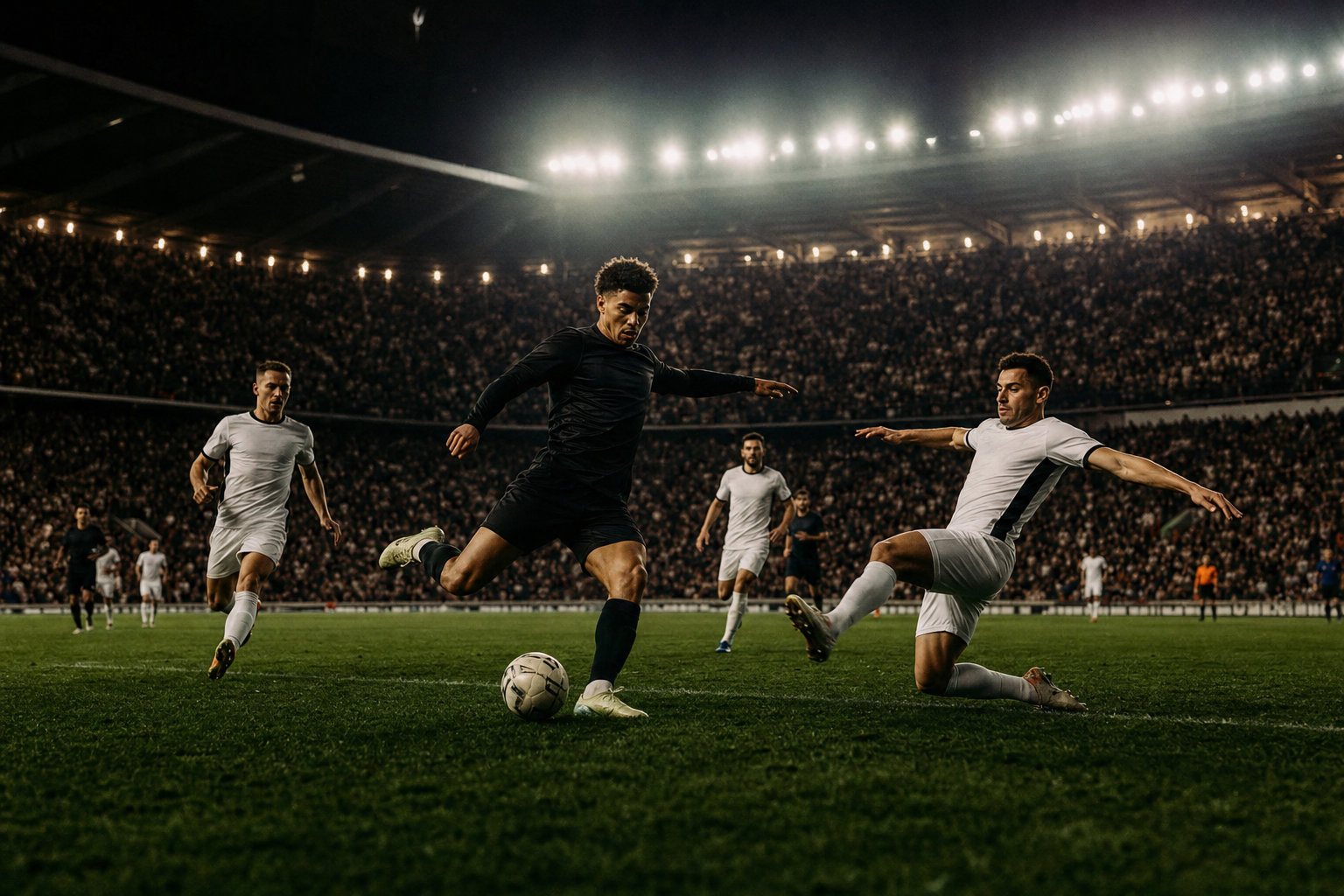
Liverpool 3–3 AC Milan — UCL Final 2005
The Istanbul comeback: how Liverpool overcame a 3-0 half-time deficit in six minutes and won the 2005 Champions League on penalties.
Three goals down at half-time in the most important match of the season, to one of the finest club sides in Europe, Liverpool's situation at the interval of the 2005 UEFA Champions League Final in Istanbul appeared not merely difficult but mathematically settled. The only question, from the perspective of the press box and the AC Milan dressing room, was whether the second half would extend the margin or simply confirm the scoreline. What followed over the next fifteen minutes of the second half — and then in extra time, and then in a penalty shootout — produced what is now simply called the Istanbul Final: European football's definitive comeback narrative, a match whose arc is so improbable that it retains the quality of myth even in sober analytical examination.
Starting Line-ups
Liverpool (4-4-2) — Manager: Rafael Benítez
Jerzy Dudek; Steve Finnan, Jamie Carragher, Sami Hyypiä, Djimi Traoré; Luis García, Xabi Alonso, Steven Gerrard, Harry Kewell; Milan Baroš, [verify 11th — contemporary sources vary].
Substitutes used: Vladimír Šmicer (for Kewell, 23') · Dietmar Hamann (for Finnan, HT) · Djibril Cissé (for Baroš, 85')
AC Milan (4-4-2) — Manager: Carlo Ancelotti
Dida; Cafu, Alessandro Nesta, [CB — verify], Paolo Maldini; Clarence Seedorf, Andrea Pirlo, Gennaro Gattuso, Kaká; Hernán Crespo, Andriy Shevchenko.
Substitutes used: Serginho (for Rui Costa or rotation, c.56') · Tomasson (for Crespo, c.80')
Starting XIs compiled from widely cited match reports and secondary sources. Milan's second CB and Liverpool's 11th player are contested across sources; UEFA official records are authoritative. Substitution timings are approximate.
Context: Liverpool's Return to European Finals
This was Liverpool's first European Cup final since 1985 — the year of the Heysel Stadium disaster in Brussels, which had resulted in the club's five-year ban from European competition and cast a long shadow over the club's relationship with continental football in the two decades that followed. The 2004–05 campaign under Rafael Benítez, who had arrived at Anfield the previous summer from Valencia, represented a return to relevance in a competition the club had defined during its sustained dominance of the late 1970s and early 1980s.
Benítez's Liverpool were not a dominant team by the conventional measures of that era's Premier League competition — they finished fifth in the domestic league that season, a significant distance behind Chelsea's title-winning side. Their Champions League campaign was built on defensive organisation, collective energy, tactical discipline in knockout matches, and the specific qualities of a squad that had been assembled to perform at its best in high-stakes, direct elimination football rather than in the attrition of a full league campaign.
The path to Istanbul had included notable victories: against Bayer Leverkusen in the group stage, against Juventus and Chelsea in the knockout rounds. Each match required Liverpool to defend deeply and counter with precision, a pattern that had become the signature of Benítez's European approach.
AC Milan: The Dominant Opponent
AC Milan in 2005 were among the strongest club sides in Europe. Under Carlo Ancelotti, Milan had won the Champions League two years earlier in the 2002–03 final — a match that had also involved a penalty shootout and, on that occasion, had gone Milan's way. The squad included Andrea Pirlo in the deep-lying playmaker role he would come to define for a generation; Kaká, the Brazilian midfielder at the peak of his creative powers; Hernán Crespo as a technically accomplished centre-forward; Clarence Seedorf providing physical and technical quality in central midfield; and Paulo Maldini, the club captain playing his twentieth season at the club, approaching the end of a career that had defined European club football's defensive standards across multiple eras.
Milan's tactical structure under Ancelotti was built around controlled possession, Pirlo's ability to dictate tempo from deep, and Kaká's capacity to accelerate in transition and create chances for Crespo and the supporting runners from midfield. Against Liverpool's defensive organisation, the question was whether Benítez's side could restrict Milan's passing rhythm sufficiently to prevent the Italian side from opening spaces in behind.
The First Half: Three Goals in Forty-Four Minutes
The answer, in the first forty-four minutes of the match, was that Liverpool could not. The opening minute of the final established the tone with brutal efficiency. Paulo Maldini, at thirty-six years old, scored directly from a corner kick taken by Andrea Pirlo — the ball swinging into the near post where Maldini arrived to direct it into the net. It was the earliest goal ever scored in a Champions League final at that point, and it immediately placed Liverpool in the position of needing to respond rather than impose their own structure on the match.
Liverpool were unable to establish any sustained possession or coherent defensive shape. Milan's movement — particularly Kaká's diagonal runs and the fluid interchange between Crespo, Kaká, and the midfield runners — consistently created uncertainty in Liverpool's defensive lines. Jerzy Dudek, Liverpool's goalkeeper, was called upon several times to prevent the lead from extending before the half-hour mark.
Hernán Crespo scored twice before half-time to make it 3-0. Both goals were created by Kaká, whose contribution in the first half was the most significant individual tactical performance of the opening forty-five minutes. The first Crespo goal came from a precise low cross; the second, a few minutes before the interval, was a chip over Dudek after Kaká's through-ball had dissected Liverpool's defensive line. Three goals in forty-four minutes, and the final appeared settled for the interval team talks.
Liverpool went into the dressing room at half-time with no realistic tactical scenario that seemed to justify optimism.
Benítez's Half-Time Intervention
What Rafael Benítez said to his squad during those fifteen minutes is documented primarily through the recollections of the players who were present — Steven Gerrard, Jamie Carragher, Vladimír Šmicer, and others have described an atmosphere of renewed determination rather than resignation. But the tactical change Benítez implemented was observable and, in retrospect, clearly significant.
Steve Finnan, Liverpool's right back who had struggled in the first half with Milan's movement on that flank, was replaced by Dietmar Hamann — a German defensive midfielder known for his positional discipline, reading of the game, and capacity to screen the back four. The substitution changed Liverpool's shape, introducing an additional midfielder to sit in front of the defence and providing a structural anchor that the first half had lacked. With Hamann providing the defensive midfield base, Steven Gerrard was freed from covering duties to operate in a more advanced position — the role in which his dynamic forward running and shooting could be most effective.
The tactical logic of the change was straightforward: three goals down, Liverpool needed goals, which required attack-minded organisation. But the method — introducing a defensive player — might seem counterintuitive. The effect was to give Liverpool defensive stability against Milan's transitions while simultaneously freeing Gerrard, who would prove to be the architect of what followed.
The Comeback: Three Goals in Six Minutes
The second half began at a different tempo. Liverpool's pressing was more organised, Hamann's presence stabilised the midfield, and the first genuine opportunity came relatively quickly after the restart.
In the 54th minute, a cross from the left — delivered with pace into the penalty area — found Steven Gerrard arriving at the far post. Gerrard's header reduced the deficit to 3-1. The goal was significant beyond its scoreline: it established, for the first time in the match, that Liverpool could breach Milan's defence, and it changed the psychological terms of the second half.
Two minutes later, Vladimír Šmicer — the Czech midfielder who had been a somewhat peripheral figure in Benítez's Liverpool squad and who would leave the club at the end of the season — struck a shot from outside the penalty area that beat Dida at his near post. The goal was part fortune, part audacity: 3-2, and the match was suddenly alive in a way that nothing in the first half had prepared any observer for.
The third Liverpool goal, in the 59th minute, came from a penalty. Xabi Alonso was brought down in the area — the referee awarded the spot kick, Dida saved Alonso's initial penalty, and Alonso, following up on the rebound, converted. 3-3. Six minutes. Three goals. The Camp Nou moment from six years earlier — the Manchester United comeback against Bayern Munich in the 1999 UCL Final — had been the previous reference point for injury-time European drama. Istanbul established its own, different, category: not a reversal in the final minutes, but a complete structural transformation of a match in the second half's opening quarter-hour.
Extra Time and Djimi Traoré's Save
The thirty minutes of extra time that followed were dominated by Milan's attempts to recover composure and find a winner, and by Liverpool's determination to maintain the defensive organisation that Hamann's introduction had established. Dudek made a crucial save in extra time to deny Andriy Shevchenko — at the time one of the three or four best strikers in European football — from close range; the save, with both hands pushing the ball over the bar, is among the images most associated with the final.
The match was decided by penalties. Dudek's eccentricity in goal during the shootout — moving along his line, shaking his limbs to distract the penalty takers — drew comparisons to Bruce Grobbelaar's similar tactics in Liverpool's 1984 European Cup final shootout victory over Roma. The technique, whatever its precise psychological effect, preceded Liverpool's eventual triumph when Dudek saved Shevchenko's final penalty to win the shootout. Liverpool had won their fifth European Cup.
Why This Match Matters Tactically
The Istanbul final offers several genuine tactical lessons beyond the obvious narrative of the comeback. The most significant is the demonstration of how a mid-game structural change — Hamann's introduction — can transform a match's competitive dynamic without requiring dramatic individual performances. Liverpool did not suddenly become better footballers in the second half. They became better organised, which created the conditions in which their best players could express their quality.
The match also illustrates the psychological fragility that can follow a goal conceded late in a half. Milan's 3-0 lead had seemed conclusive, and the structural complacency that a large margin can produce — the slight reduction in defensive intensity, the partial disengagement from pressing triggers — contributed to the conditions in which the comeback was possible. This is not a criticism of Ancelotti's management; it is a description of how football matches work at the level of human psychology and competitive attention.
Legacy
The Istanbul comeback is now one of the fixed reference points in any discussion of football's capacity for dramatic reversal. It is discussed not only in football contexts but in the broader literature of sport psychology, resilience, and collective belief — qualities that the match illustrated with unusual clarity and at an unusually high-profile level.
For Liverpool, the victory represented not only the club's fifth European Cup but a reassertion of an identity that had been dormant since the mid-1980s. The night in Istanbul provided the foundation for a period of renewed Champions League ambition at Anfield that would eventually produce the club's sixth European Cup under Jürgen Klopp in 2019.
For those seeking context on Liverpool's domestic competition in the era surrounding this final, the Premier League archive documents the competitive landscape of the mid-2000s in which Benítez built his European-focused squad. The full match archive contains further documentation of European finals and landmark knockout ties from the Champions League era.
Frequently Asked Questions
What happened in the 2005 Champions League final in Istanbul?
Who managed Liverpool that night?
Why is Liverpool's starting eleven marked as unverified on this page?
What makes this final tactically interesting?
Football Replay Editorial
Updated April 11, 2026